
“Blow, winds, and crack your cheeks! rage! blow!”
— William Shakespeare, King Lear, Act 3, Scene 2
Overview
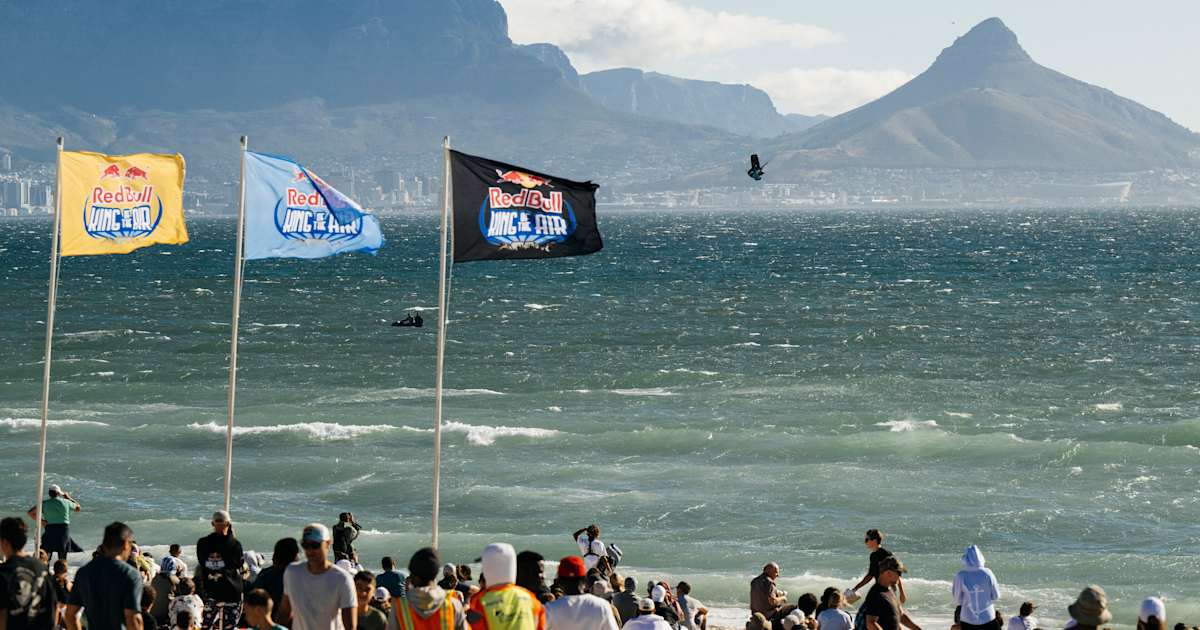
The fierce “Cape Doctor” winds howling through the skies of South Africa. Only those who can conquer this overwhelming force of nature and soar the highest and most extreme can claim the title of “King of the Air.” The Red Bull King of the Air (KOTA) is not just a kiteboarding competition; it is the living history of an extreme sport constantly pushing past its limits.
The Hawaiian Craze and the Hiatus Due to Changing Styles
The origins of KOTA can be traced back to 1998, when the first official kiteboarding world championship was held in Maui, Hawaii, won by Flash Austin. The following year, in 1999, Red Bull officially became the sponsor, and the inaugural “Red Bull King of the Air” was held at Ho’okipa, Maui’s sacred windsurfing spot. Back then, kites were raw and powerful, and riders focused entirely on one thing: going as high as possible. The monumental first champion was the living legend of water sports, Robby Naish, who had become a windsurfing world champion at the age of 13 (though some sources cite 2000 as the start due to later standardization, Naish won the historical first edition in 1999). Anne Laure Pegon was crowned the inaugural Queen of the Air that same year.
Following them, Flash Austin claimed the title in 2000 (with Julie Prochaska winning the women’s division). After the event was not held in 2001, Mark Shinn achieved an unprecedented Triple Crown in 2002 alongside women’s champion Sheldon Plentovich. Charles Deleau won in 2003, and Tuterai Montaron from Bora Bora claimed victory in 2004. Susi Mai also dominated the women’s division, securing back-to-back victories in 2003 and 2004, electrifying the beach crowds.
However, as equipment evolved and became more accessible, top riders shifted their focus to a more technical, wakeboard-like style closer to the water’s surface. The passion for Big Air temporarily cooled, and the event began to feel somewhat stagnant. After 17-year-old Ruben Lenten (and Susi Mai completing her three-peat in the women’s division) won in 2005, the Maui era of KOTA entered a long hiatus.
The Rebel’s Challenge and the Birth of Modern KOTA in Cape Town
During this hiatus, the “Master of Extreme,” Ruben Lenten, was deeply frustrated with the competition formats of the time. Around 2007, he began experimenting in storm-force winds that nobody else wanted to ride in, throwing massive 12-meter-plus “megaloops.”
This pursuit of the extreme led to the “Red Bull Len10 Megaloop Challenge” at Big Bay in Cape Town, South Africa, in 2012. The following year, in 2013, KOTA finally made its triumphant return after an 8-year break. That year, Hawaiian Jesse Richman—hailed as a prodigy since age 10 and who would later set a 220m tow-in hangtime record—claimed the throne after a grueling 8-hour battle.
In 2014, Kevin Langeree won his first title in front of a massive 12,000-strong crowd. The next year, Aaron Hadlow executed his legendary “Megaloop KGB” twice in flawless fashion to take the top spot, proving that equipment advancements had pushed the competition to an entirely new dimension. In 2018, seeking stronger and more consistent winds, the event relocated to Kite Beach, where extreme conditions allowed the tournament to evolve even further.
The Ultimate Underdog System and Ruthless Format
Reaching the KOTA stage is no easy feat. The system constantly unearths new talent through “Golden Tickets” awarded at “Fly-to” events worldwide, “video entries” that allow unknown riders to rise through sheer skill, and the recently established “Porsche Golden Ticket” for rising rookies.
The competition format is also uniquely KOTA. In Round 1, a ruthless “flag-out” rule is enforced, where the rider with the lowest score mid-heat is flagged from the beach and forced to exit the water immediately. The scoring system has also evolved: each trick is judged based on “height, extremity, diversity, and innovation.” In addition to the top trick scores, a “Variety Score” evaluates how well a rider covered different trick families throughout the heat. This often leads to dramatic, mind-blowing comebacks that keep the crowd roaring.
The Rise of a New Generation and the Return of the Queens
Due to the pandemic, the event shifted its schedule to the end of the year from 2020 onward. This change proved successful, as it aligned perfectly with the prime “Cape Doctor” wind season.
In recent years, the competition has entered a new phase. In 2022, 18-year-old rookie Lorenzo Casati seized the victory in his debut, and the podium was completely swept by three first-time finalists, showcasing a vivid generational shift.
Even more thrilling is the dramatic evolution of the female riders. It all sparked when Angely Bouillot entered the men’s division and threw massive loops, shocking the world and elevating the standard for all women. In 2024, the highly anticipated Women’s Division officially returned, and Francesca Maini was crowned the first queen of this new era.
Past Champions List
KOTA 1999: Robby Naish / Anne Laure Pegon (Women’s)
KOTA 2000: Flash Austin / Julie Prochaska (Women’s)
KOTA 2001: No Event Held
KOTA 2002: Mark Shinn / Sheldon Plentovich (Women’s)
KOTA 2003: Charles Deleau / Susi Mai (Women’s)
KOTA 2004: Tuterai Montaron / Susi Mai (Women’s)
KOTA 2005: Ruben Lenten / Susi Mai (Women’s)
KOTA 2013: Jesse Richman
KOTA 2014: Kevin Langeree
KOTA 2015: Aaron Hadlow
KOTA 2016: Aaron Hadlow
KOTA 2018: Kevin Langeree
KOTA 2019: Kevin Langeree
KOTA 2020: Jesse Richman
KOTA 2022: Lorenzo Casati
KOTA 2024: Andrea Principi / Francesca Maini (Women’s)
Show Latest Event Results (Spoilers)
KOTA 2025: Lorenzo Casati / Nathalie Lambrecht (Women’s)
Search Aliases: Red Bull King of the Air, RedBullKingoftheAir, King of the Air, KingoftheAir, KOTA