
What is Upwind Riding?
In kiteboarding, “upwind” refers to the technique of riding against the direction of the wind. It is an essential basic skill that allows a rider to return to their starting point and freely navigate the water. Mastering this technique eliminates the need for the “walk of shame” (carrying equipment back up the beach after drifting downwind). Successfully riding upwind requires not only leg strength but also maintaining proper posture, precise kite control, and a deep understanding of the physical mechanics of apparent wind.
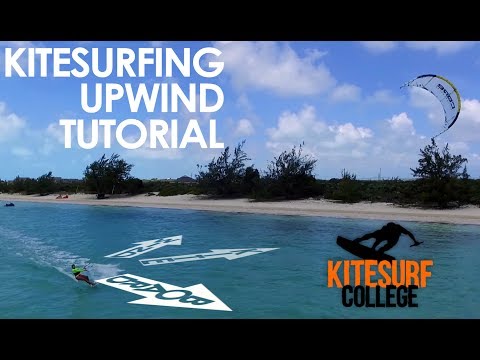
Basic Posture and Control Techniques
The success of upwind riding is determined by the proper balance and coordination of the body, board, and kite.
Fixing Your Gaze and Checking Position
The fundamental rule is to always look in your intended direction of travel (upwind). Turning your head upwind naturally opens your chest, optimizing your upper body posture for the direction of travel. Additionally, setting a specific landmark or structure on the shore serves as an objective reference point to verify if you have successfully gained ground upwind after executing tacks.
Optimal Kite Angle
Within the “wind window,” the kite should be maintained at an angle of about 45 degrees relative to the water surface (the 10:30 or 1:30 position on a clock face). If the angle is too high, the rider is pulled upward, causing the board’s edge to slip; if too low, the downwind pull becomes excessive.
Posture and Rail Weight Distribution
Weight should be shifted towards the rear (back leg), but to prevent the hips from sticking out backward, the pelvis must be pushed forward in the direction of travel. The front knee should be slightly bent to absorb impact, allowing the entire heel-side rail of the board to bite into the water, preventing downwind drift and establishing a foundation for forward propulsion.
Technical Points for Improving Glide Efficiency
If you cannot ride upwind despite maintaining a basic posture, making the following technical adjustments can improve your efficiency.
- Depowering the Control Bar (Pushing Out): Continuously pulling the control bar to maintain speed or power deepens the kite’s angle of attack, increasing the downwind drag. By maintaining the edge and moderately pushing the bar forward (depowering), the kite moves toward the edge of the wind window, converting the pull into forward propulsion.
- Fine-Tuning Bar Pressure: Natural wind constantly fluctuates between gusts and lulls. Pushing and pulling the bar in small increments to match these fluctuations ensures a constant pull and speed, which is directly linked to stable upwind riding.
- Stance Weight Adjustment: Applying excessive weight solely on the heel of the back foot causes the rear of the board to sink deeply, acting as a brake and reducing speed. Moving the back foot slightly toward the center of the board or consciously using the entire rail and fins to handle water resistance will improve glide efficiency.
Common Mistakes
- Changing Direction with Insufficient Speed: Turning the board too far upwind immediately after starting will result in a lack of propulsion, causing you to stall and sink. The basic approach is to point the board slightly downwind initially, gain sufficient speed (planing), and then gradually correct the trajectory upwind.
- Stalling Due to an Excessive Upwind Angle: If the angle of approach upwind is too sharp, the board’s water resistance will exceed the kite’s propulsion, causing a stall. If you sense a stall, immediately ease off the edging and point the board downwind, or swoop the kite to regain power.
- Poo Stance: A stance with the hips pushed backward prevents weight from being properly transferred to the harness or the board’s rail, causing propulsion to be lost and resulting in drifting downwind.
The Mechanics of Apparent Wind and Speed
Understanding the “apparent wind” concept—the vector relationship between wind and speed—is crucial for grasping the mechanics of riding upwind.
Components of Wind and Apparent Wind
The wind experienced by the rider is the “apparent wind,” which is a combined vector of the “true wind” blowing in the natural environment and the “induced wind” (headwind) generated by the rider’s own moving speed. The kite’s wind window is formed based on this apparent wind.
Regression of the Wind Window with Increased Speed
It is a common misconception that “increasing speed pushes the kite forward due to apparent wind, allowing you to ride upwind,” but mechanically, the opposite is true. As speed increases, the induced wind (headwind) strengthens, causing the direction of the apparent wind to shift further forward (towards the front of the rider). Since the wind window forms perpendicular to the apparent wind, a forward shift in the apparent wind causes the entire wind window to shift relatively backward (downwind) from the rider’s perspective. Consequently, the kite enters a deeper position (closer to the power zone) in the wind window, increasing the downwind pull.
Offsetting and Propulsion via Edging Power
The reason upwind riding is possible despite the kite sitting deeper and pulling harder lies in the board’s lift generated by speed. As speed increases and the board begins planing, the fins and rails grip the water powerfully, allowing for extremely strong edging. This powerful edging counters the kite’s massive pull, and by pushing the bar out to force the kite towards the window edge, sharp upwind propulsion is achieved. In short, without speed, sufficient edging is impossible, and the rider will lose to the kite’s pull.
The Negative Spiral in Light Wind
In light wind conditions, trying to gain propulsion at the start by riding downwind creates an induced wind that blows from behind. This cancels out the weak true wind, further reducing the apparent wind acting on the kite, often causing the kite to stall and fall in a negative spiral.
Impact on Apparent Wind in Strong Wind
In strong true wind conditions, the proportion of induced wind generated by the rider’s speed in the combined vector is relatively small. Therefore, in strong winds, generating speed does not cause a significant forward shift in the apparent wind, keeping the wind window from shifting backward. If the rider has the skill to control the overpowering force through edging, it is possible to achieve a much higher upwind angle in strong winds than in light winds.
Upwind Body Dragging
The technique of moving upwind without a board, or in situations where a board cannot be used, is known as “upwind body dragging.” This is an essential self-rescue skill when the wind drops, preventing riding, or when recovering a lost board.
- Body Dragging Using Only the Body: Release the front hand from the control bar and extend it straight ahead in the direction of travel. Keep the kite at 45 degrees, bring your legs together, and use your entire body as a rudder to create water resistance, enabling upwind movement.
- Body Dragging Using the Board: This is highly effective when the board has been recovered, but the wind is too light to ride. Grip the downwind rail or foot strap from underneath with your front hand, and rest your elbow or forearm on the upwind rail to stabilize it. This allows the board itself to act as a keel or a large fin, enabling movement upwind with drastically higher efficiency and angle compared to body dragging alone.
Selecting Gear Based on Environmental Conditions
Regardless of a rider’s skill level, a mismatch between wind speed and equipment is often the cause of difficulty in riding upwind.
Gear Characteristics for Light Wind
Light wind is the most difficult condition for riding upwind because it is easy to fall into the aforementioned “negative spiral,” making it hard to maintain speed. Equipment must be configured to minimize water resistance and maintain planing with minimal pull.
- Boards: A long, wide light-wind board (door board) with a flat rocker is ideal. Notable models include the Slingshot “Glide” and the Duotone “Spike.”
- Kites: A lightweight kite that can maintain flight even in weak wind and easily move to the window edge is suitable. The “1-strut kite,” designed with reduced structural materials for lighter weight, is mainstream. Representative models include the Duotone “Mono,” Ozone “Alpha,” F-ONE “Breeze,” and Cabrinha “Contra 1S.”
Gear Characteristics for Strong Wind
While strong winds mitigate the negative impacts of apparent wind changes, the kite’s pull can become excessive (overpowered), increasing the risk of being dragged downwind if edging cannot control it.
- Kites: It is recommended to choose a kite slightly smaller than the standard appropriate size. It is much easier to maintain stable edging with a smaller kite than attempting to forcefully control a heavily depowered large kite.
- Boards: Because chop and waves easily form in strong winds, a slightly smaller board with moderate rocker is ideal, as it is less likely to bounce off the water surface. Ensuring the rail holds securely against the water enables stable upwind riding.
Search Aliases: to ride upwind, torideupwind, Upwind Mechanics and Techniques: A Complete Guide to Riding Upwind, UpwindMechanicsandTechniques:ACompleteGuidetoRidingUpwind